The company graph: memory that compounds.
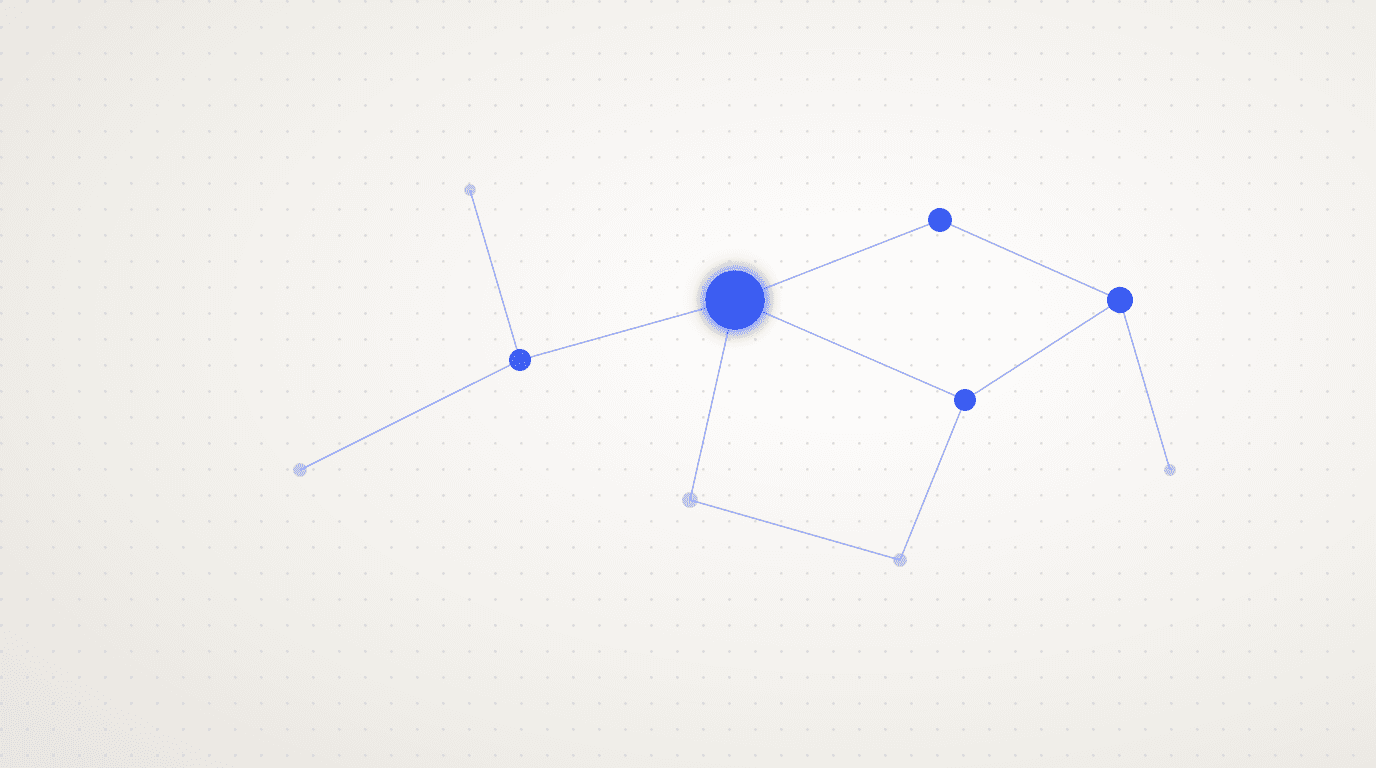
An AI that remembers your business carries a company knowledge graph: a private, structured map of the people, deals, tools, and decisions that make up how you actually operate. Most AI tools have the memory of a goldfish. You explain your biggest customer on Monday, and by Thursday the same tool asks who they are, with a completely straight face. A company knowledge graph fixes the goldfish problem by storing what the AI learns while it works, so context piles up from one conversation to the next. That is the gap between a chatbot that answers questions and an operator that already knows the answers. Clark, the AI operator made by Weblyfe, is built around this idea.
What is a company knowledge graph?
A company knowledge graph is a living record of your business stored as connected facts. A knowledge graph represents information as entities and the relationships between them. In a company's case, the entities are the nouns you deal with all day: customers, suppliers, invoices, projects, tools, and the people who touch each one. The relationships give those nouns their meaning: this customer belongs to that account manager, that invoice traces back to this project, and this decision was made for that reason.
A graph gets its value from the links between facts. When Clark knows that a customer is tied to three open deals, two past support headaches, and one firm opinion about never being called before noon, it can answer a question about that customer with the whole picture. The graph holds both the contents of your business and its shape.
How a graph differs from a database
A traditional database stores rows in tables you have to design before anything useful can go into them. A graph grows the other way around. You add facts and connections as they show up in real work, so nobody has to model the entire company on a whiteboard before Clark earns its keep. The structure assembles itself while Clark handles actual tasks, which means it mirrors how your business runs in practice. You can see how this looks on the Clark graph page.
Why does an AI that remembers your business matter?
It matters because context is the expensive part, and most tools bill you for it over and over. Picture a sharp new hire in week one. They are slow because they do not yet know your customers, your suppliers, your history, or the small reasons behind the way things get done. They ask, they double-check, and they tap the shoulder of the one person who already has the answer. Over a few weeks the questions dry up and they get faster, because the answers have moved from your head into theirs.
Clark starts in that exact spot. On day one it knows the tools and the task and almost nothing about your particular corner of the world. Every task Clark finishes feeds the company knowledge graph, and every answer it gives draws on that same graph. What it learns stays after the session closes and connects to what came before, so the next task starts from a higher floor.
That is why Clark speeds up the longer it runs: the work compounds. We got into the reasoning behind all of it in why Clark exists.
How is the graph built from real work?
The graph is built from the tasks Clark does, starting with the first job you hand it, so you can skip the month of feeding it documents and hoping. Clark does the work and, along the way, writes down what it learned in a form it can pick up again later.
In practice, Clark works through an email thread with a supplier and records who they are, what they provide, and the terms on the table. Later it prepares an invoice and links that invoice to the right customer and project. Later still, someone asks about outstanding payments on that project, and Clark answers from connections it already made. Each action leaves the graph a little richer than it found it.
Two things follow from building it this way:
- It stays accurate. The graph reflects work that actually happened, because it is assembled from that work.
- It stays relevant. Clark records the things it needs to get your tasks done. The graph grows toward the parts of your business you lean on most, because those are the parts it keeps touching.
Why does memory compound over weeks and months?
Memory compounds because context you explain once stays explained. The first time you point Clark at a job involving a particular client, you might walk it through the relationship, the history, the preferences. The second time you explain less, and by the tenth time close to nothing, because the explanation has moved out of your head and into the graph, where it stays.
A single fact about a customer is handy on its own. Wired to their deals, their invoices, their contacts, and their history, the same fact becomes far more useful, because Clark can walk the links and assemble context you never thought to spell out. Ask about one thing and everything attached to it comes along for the ride.
Compounding memory is boring the way a savings account is boring. Nothing seems to happen, nothing seems to happen, and then one quarter you notice the interest is doing most of the work. You pay in context the first week, and from then on the graph covers a growing share of the bill.
The practical payoff over time
In the first week, Clark is a capable operator still learning your specifics, and you will explain things, the same way you would when onboarding any new hire.
Over the following weeks, tasks that used to need three rounds of back-and-forth start landing on the first try. Clark stops asking who a contact is, because it filed them away last month. It stops asking how you handle a certain kind of request, because it has handled that kind of request for you before. You spend less time re-explaining yourself. We walked through what those early days feel like in a week with your Clark.
Over months, the graph becomes a real asset: a structured account of how your business runs, drawn from actual work and ready to answer questions and drive tasks. The longer Clark runs, the more the graph holds and the faster Clark works.
Where does the data live?
The graph is built on your own machine, from your own work, and it stays with you. This is a deliberate choice and central to how Clark works. The company knowledge graph is locally hosted: a private record of your business, kept where you can see it and control it.
Your data does not train a general model in a warehouse three time zones away, and your business never dissolves into a large shared system. The graph is yours in the literal sense: it sits on your machine, holds your facts, and stays under your ownership. If the relationship ever ends, your knowledge stays where it was built.
For any business handling customer details, supplier terms, and internal decisions, where the data lives matters a great deal, and Clark's answer is to keep the graph close to home.
What are Clark's limits?
Clark starts slow, the same way a new hire starts slow, and the compounding takes real time to show up. The graph is thin on day one, and its value builds up over weeks of real work. Anyone promising an AI that knows your business the second you switch it on is describing a graph that does not exist yet.
The graph is also only as good as the work it sees. Clark records what it does, so the graph grows where you put Clark to work and stays blank in the corners of your business it never touches.
Clark is an operator that remembers and compounds, and it makes no claim to general intelligence or full autonomy. It does tasks, records what it learns, and reuses that knowledge to do the next task better.
The takeaway
An AI that remembers your business earns its place faster than a cleverer one that forgets you by lunchtime. The company knowledge graph turns a capable stranger into an operator who knows your customers, your suppliers, and your history. It is built from real work, it lives on your machine under your ownership, and it compounds. The first week costs you context, the way every onboarding does. Every week after, you spend less and get back more, because the knowledge stays put and keeps finding new things to connect to.
Clark is in Public Beta. A seat is 250 EUR per month, and that price stays locked for as long as you stay subscribed, against a launch price of 488 EUR per month. If you want an AI working for you that remembers your business, beta is the moment to start building the graph, because the graph you start today is the one paying you back in October. You can see how it fits the whole product on the Clark site.